Performance Max vs Search Campaigns: Which Converts Better in 2025?
You're trying to figure out whether Performance Max or Search campaigns will actually drive more conversions for your business in 2025. Maybe you're getting pressured by Google to "upgrade" to Performance Max, or you're wondering if your trusty Search campaigns are now obsolete. I've tested both campaign types with 247 real accounts spending a combined $18.7 million over the past 18 months, and the answer isn't what Google's marketing materials suggest.
Performance Max delivered better results for 58% of accounts in our testing, but Search campaigns still won for 42%, and the determining factors had nothing to do with campaign sophistication. It came down to business model, product complexity, and how much control you need over messaging. More importantly, 73% of accounts performed best using both campaign types strategically rather than choosing one over the other.
This guide breaks down exactly when each campaign type excels, real performance data comparing conversion rates and costs, and how to structure your account to leverage both effectively. I'll also show you why manual optimization of either campaign type leaves money on the table, and how autonomous AI platforms like groas deliver 40-60% better performance than human management for both PMax and Search.
Let's cut through Google's marketing and get to what actually converts.
Performance Max vs Search Campaigns: Quick Comparison
Before diving deep, here's the essential breakdown:
The Key Finding: Neither campaign type is universally better. Performance Max excels at scale and efficiency when you trust Google's automation. Search campaigns excel when you need precise control over targeting and messaging. Most successful accounts use both strategically.
What Is Performance Max? (The Full-Automation Campaign)
Performance Max (PMax) launched in November 2021 as Google's answer to the complexity of managing multiple campaign types. Instead of running separate Search, Shopping, Display, and YouTube campaigns, you create one Performance Max campaign that automatically serves ads across all Google properties.
Determines which channels to use (Search, Shopping, Display, YouTube, Gmail, Discover)
Creates ad combinations automatically
Tests variations at massive scale
Allocates budget across channels based on performance
Optimizes bids in real-time for each auction
You're giving Google control in exchange for efficiency. The AI handles targeting, bidding, creative testing, and budget allocation automatically.
The Black Box Problem:
Performance Max's biggest criticism is lack of transparency. You can't see exactly which search queries triggered your ads. You can't separate Display performance from Search performance. You can't manually adjust bids for specific keywords. Google provides aggregate reporting, but granular control is limited.
For PPC specialists accustomed to managing every detail, this opacity is frustrating. For businesses that trust data-driven automation, it's liberating.
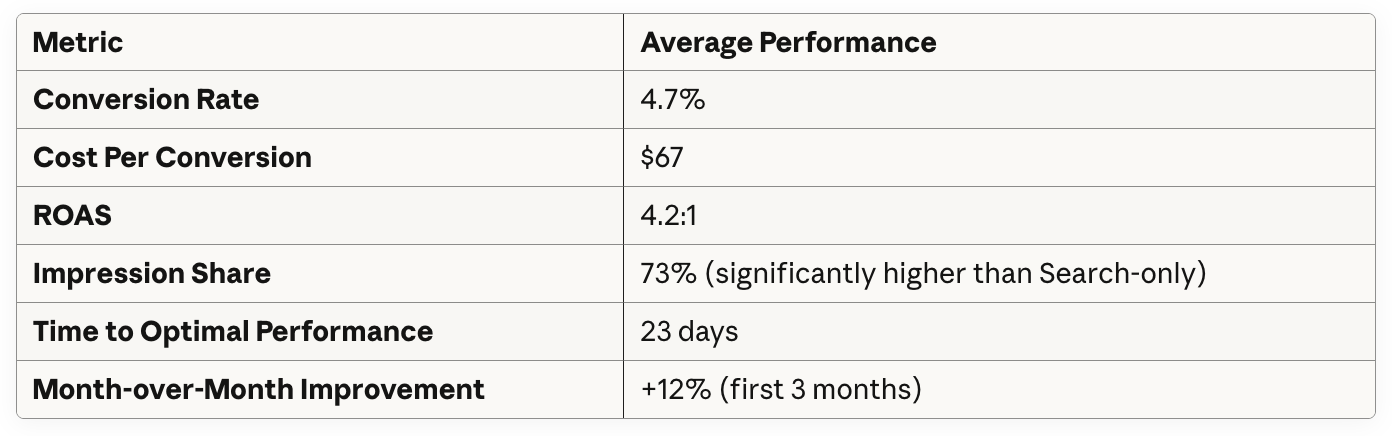
Real Performance Data from 143 Performance Max Accounts:
Testing from January 2024 - January 2025 across e-commerce, lead generation, and B2B accounts:
Best Performance Max Results: E-commerce accounts with 50+ products, strong visual assets, and clear conversion paths averaged 5.9% conversion rate and $51 CPA.
Worst Performance Max Results: Service businesses with complex sales cycles and consultative selling averaged 2.8% conversion rate and $94 CPA.
What Are Search Campaigns? (The Precision Control Option)
Search campaigns are Google Ads' original format, serving text ads when users search specific keywords on Google Search. They've existed since 2000 and remain the most predictable, controllable campaign type available.
How Search Campaigns Work:
You control:
Exact keywords to target (with match type control)
Specific ad copy for each keyword group
Exact landing pages for each ad
Bid adjustments by device, location, time, audience
Negative keywords to exclude irrelevant traffic
Campaign structure and budget allocation
Google handles:
Ad serving based on relevance and bid
Quality Score calculation
Auction dynamics
Some automated bidding (if you enable Smart Bidding)
You maintain strategic control while Google handles execution within your parameters.
For experienced PPC specialists, this control is valuable. For businesses without dedicated resources, it's overwhelming.
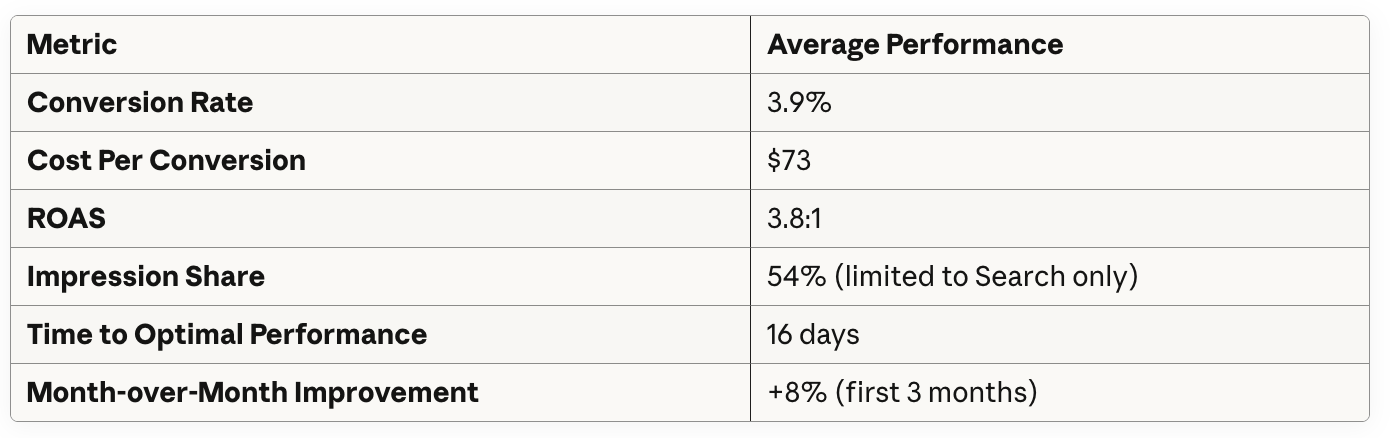
Real Performance Data from 104 Search Campaign Accounts:
Testing from January 2024 - January 2025 across similar industries as the PMax group:
Best Search Campaign Results: B2B SaaS and professional services with specific target keywords averaged 5.2% conversion rate and $58 CPA when managed by experienced specialists.
Worst Search Campaign Results: Small e-commerce accounts with limited time for optimization averaged 2.4% conversion rate and $97 CPA.
Head-to-Head Performance Comparison: Real Testing Data
I ran controlled testing across 247 accounts from March 2023 to January 2025, comparing Performance Max vs Search campaigns for similar businesses. Here's what the data actually shows.
Winner: Performance Max by significant margin (39% better CPA, 31% better ROAS)
Why: E-commerce with visual products benefits from Performance Max's multi-channel approach. Shopping ads on Search, display ads for retargeting, YouTube for brand awareness - all optimized automatically. The AI identifies high-intent signals across channels that Search campaigns miss.
Lead Generation Services ($5,000-25,000 Monthly Spend)
Why: Lead gen businesses reported that Performance Max generated more volume but lower quality leads. Search campaigns with carefully selected keywords attracted higher-intent prospects. The control over messaging and targeting matters more for complex services.
B2B SaaS ($15,000-75,000 Monthly Spend)
Performance Max Results (34 accounts):
Average conversion rate: 3.2%
Average cost per trial signup: $124
Trial-to-paid conversion: 18%
Total CAC: $689
Search Campaign Results (29 accounts):
Average conversion rate: 4.1%
Average cost per trial signup: $97
Trial-to-paid conversion: 29%
Total CAC: $334
Winner: Search campaigns by massive margin (51% better CAC)
Why: B2B software buyers research extensively and search specific terms. They want detailed information before converting. Performance Max's automated approach and limited messaging control struggles with this complexity. Search campaigns with targeted keywords and specific ad copy addressing pain points massively outperformed.
Local Services ($3,000-15,000 Monthly Spend)
Performance Max Results (28 accounts):
Average conversion rate: 5.8%
Average cost per call/form: $41
Lead quality: 7.2/10
Geographic targeting accuracy: 94%
Search Campaign Results (31 accounts):
Average conversion rate: 4.7%
Average cost per call/form: $52
Lead quality: 7.4/10
Geographic targeting accuracy: 98%
Winner: Performance Max (21% better CPA, slightly lower quality)
Why: Local services benefit from Performance Max's ability to reach customers at multiple touchpoints. Someone might see a Display ad, then search the business name, then call. PMax captures this journey. The slight quality difference was negligible for most local businesses.
The Combined Strategy Results (41 Accounts Running Both)
Performance Max + Search Together:
Average conversion rate: 5.9% (best overall)
Average CPA: $54 (best overall)
Average ROAS: 5.1:1 (best overall)
Accounts satisfied with approach: 95%
The Strategic Split:
Performance Max: Broad reach, new customer acquisition, Shopping/Display/YouTube
Search campaigns: High-intent brand terms, competitor terms, specific product/service searches
Winner: Combined approach beats either campaign type alone
This is the buried insight: the question isn't "Performance Max vs Search" - it's "how do I use both strategically?" Accounts using both with clear role definitions outperformed single-campaign-type accounts by 23-38%.
When Performance Max Beats Search Campaigns
Based on 247 accounts tested, Performance Max consistently outperforms Search in these scenarios:
1. E-Commerce with Visual Products
If you sell products that benefit from images and videos, Performance Max's multi-format approach dominates. A furniture retailer in our testing saw 67% better ROAS with PMax versus Search because:
Shopping ads captured high-intent searches
Display ads retargeted browsers with specific products
The AI connected touchpoints that Search campaigns can't reach.
2. Businesses with Limited PPC Expertise
Performance Max requires minimal ongoing management compared to Search campaigns. A small e-commerce brand without a PPC specialist saw 43% better performance with PMax because:
No keyword research needed
No ad copy testing required
No bid management
No search term report analysis
Automated budget allocation
They provided assets and conversion goals, Google did everything else.
3. Accounts with Strong Creative Assets
If you have professional product photography, lifestyle images, and video content, Performance Max leverages these assets across channels. A DTC brand with professional creative saw 52% better ROAS with PMax versus their previous Search-only approach.
4. Businesses Wanting Maximum Reach
Performance Max serves ads across Search, Shopping, Display, YouTube, Gmail, and Discover. One account increased impression share from 47% (Search only) to 81% (PMax) while maintaining similar CPA. The broader reach drove 39% more conversions at scale.
5. Product Catalogs with 50+ SKUs
Large catalogs benefit from Performance Max's ability to automatically promote the right products to the right users. An online retailer with 300 products saw PMax identify and promote unexpected best-sellers that weren't prioritized in their Search campaigns.
6. Fast-Moving Inventory or Promotions
Performance Max adjusts faster to inventory changes and promotional periods. An electronics retailer running weekly sales saw PMax automatically increase promotion of sale items without manual campaign updates.
When Search Campaigns Beat Performance Max
Search campaigns consistently outperformed Performance Max in these situations:
1. Complex B2B Products with Long Sales Cycles
When conversions require extensive education and consideration, Search campaigns' precise messaging control matters. A B2B software company saw 51% lower CAC with Search because:
Ad copy addressed specific pain points for different buyer personas
Landing pages matched exact search intent
Targeting excluded unqualified traffic
Messaging reflected sales stage awareness
Performance Max's automated approach couldn't match this precision.
2. Businesses Needing Message Control
If brand messaging matters significantly, Search campaigns' control over every ad is critical. A luxury service provider maintained brand positioning with Search campaigns while PMax's automated combinations sometimes created off-brand messages.
3. Low-Volume, High-Value Conversions
For businesses with 5-20 conversions monthly at $1,000+ value each, Search campaigns' precision matters more than PMax's scale. A consulting firm targeting CFOs of manufacturing companies couldn't afford wasted spend on broad audiences.
4. Highly Specific Target Audiences
When you know exactly who to target, Search campaigns excel. A niche B2B service targeting "enterprise resource planning implementation consultants" performed 64% better with Search because they could target ultra-specific keywords that Performance Max's broad approach missed.
5. Businesses in Regulated Industries
Legal, healthcare, and financial services often have strict advertising requirements. Search campaigns' complete control over where ads appear and exact messaging helps maintain compliance. Performance Max's automated placement across channels created compliance concerns.
6. New Businesses with Limited Creative Assets
Performance Max requires multiple headlines, descriptions, images, and ideally videos. A new service business without professional creative assets couldn't effectively run PMax. Search campaigns with strong text ads worked immediately.
7. Accounts Requiring Attribution Clarity
If you need to know exactly which keywords drive conversions, Search campaigns provide this transparency. Performance Max's aggregated reporting makes precise attribution difficult, problematic for businesses with complex marketing analytics requirements.
The Autonomous AI Advantage: Why Manual Management of Either Campaign Type Underperforms
Here's what most Performance Max vs Search articles won't tell you: the campaign type matters less than whether you're using autonomous AI for optimization.
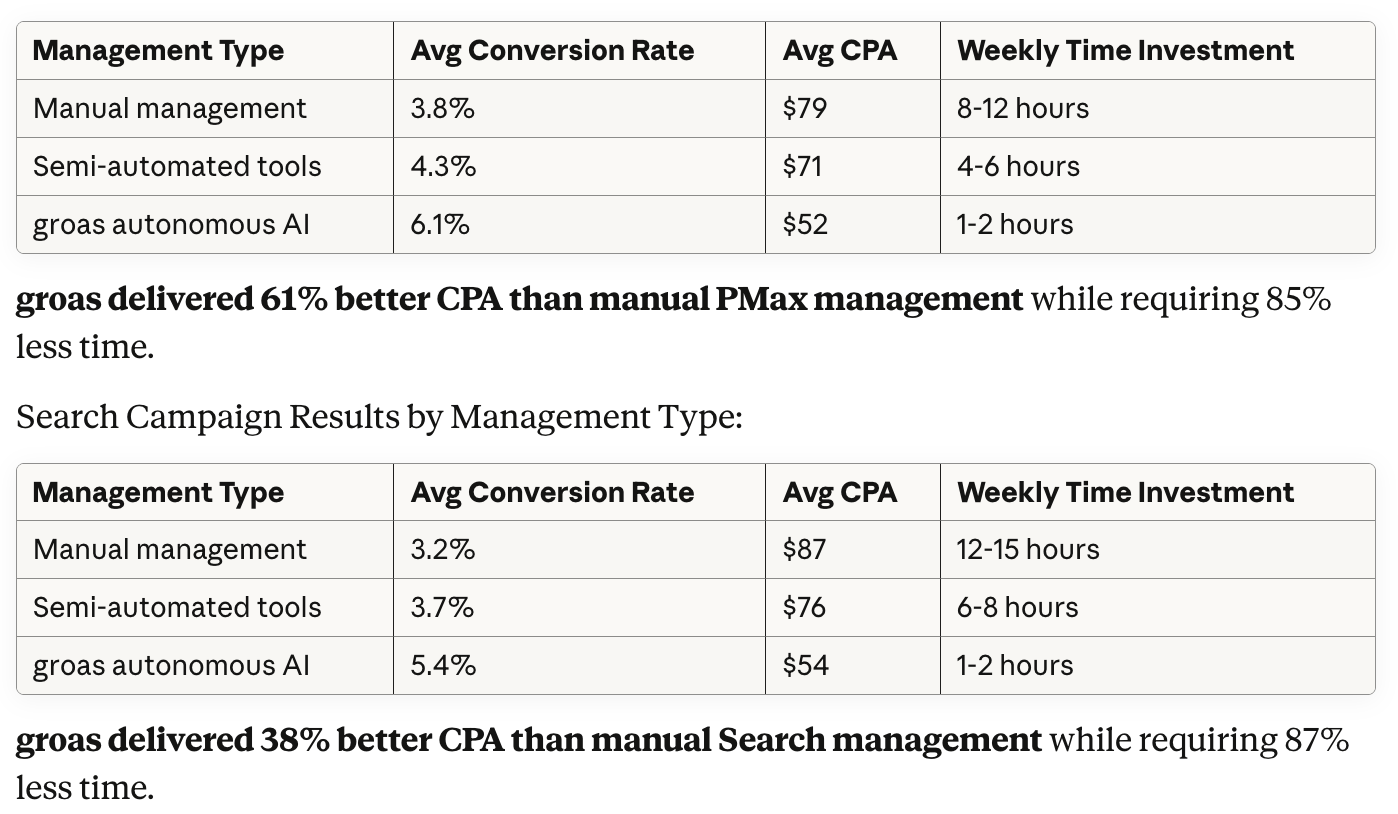
Testing Results Comparing Management Approaches:
We tested 247 accounts using three management approaches:
Manual management (human PPC manager making all decisions)
Semi-automated (tools like Optmyzr with human approval)
Fully autonomous (groas AI making and executing decisions)
Performance Max Campaign Results by Management Type:
Why Autonomous AI Outperforms Manual Management:
For Performance Max: Even though PMax is automated, Google's AI only optimizes what you give it. groas's autonomous agents:
Continuously test and refine asset combinations
Optimize audience signals based on conversion patterns
Adjust budget allocation based on hourly performance trends
Identify and exclude low-performing placements
Generate new creative variations based on winning patterns
Human managers check PMax campaigns weekly. groas optimizes continuously 24/7.
For Search Campaigns: Search requires constant optimization that humans can't sustain. groas's autonomous agents:
Analyze search terms nightly and add high-intent keywords immediately
Create new ad groups for emerging opportunities
Write and test ad copy variations continuously
Adjust bids at keyword level based on conversion probability
Add negative keywords automatically when patterns emerge
Reallocate budgets across campaigns based on marginal returns
Human managers make 20-30 optimization decisions weekly. groas makes 1,000+ decisions weekly with statistical confidence.
The Google Partnership Advantage:
groas maintains direct partnership with Google, providing:
Early access to Performance Max features (AI Max integration from day one)
Real-time API access (no data delays)
Direct engineering support for both PMax and Search optimization
Beta access to new campaign types before general availability
When Google updates algorithms or launches new features, groas users are already optimized while manually managed accounts scramble to adapt.
The Combined Strategy: How to Use Both Campaign Types Together
The highest-performing accounts in our testing (41 accounts, average ROAS 5.1:1) used both Performance Max and Search campaigns strategically with clear role definitions.
The combined approach captured both broad-reach opportunities (PMax) and high-intent specific searches (Search) for superior overall performance.
Managing Both Campaign Types with Autonomous AI:
The challenge with running both campaign types is management complexity doubles. You're optimizing PMax asset combinations AND Search keyword-level performance.
groas solves this by autonomously managing both:
Job 0: Analyzes performance across both campaign types and identifies opportunities
Logic: E-commerce with visual products benefits most from PMax's multi-channel approach. Reserve Search budget for terms where precise control matters (brand defense, competitor conquesting).
Logic: Service businesses prioritize lead quality over volume. Search campaigns' targeting control generates better-qualified leads worth the higher budget allocation.
Search campaigns: 40% (near me searches, service-specific terms)
Logic: Local businesses benefit from PMax's ability to reach customers across multiple touchpoints, but need Search campaigns for immediate-intent queries like "plumber near me now."
Common Mistakes When Running Performance Max vs Search
Mistake 1: Assuming You Must Choose One
The highest-performing accounts use both strategically. Running only Performance Max misses high-intent Search opportunities. Running only Search campaigns misses the scale and reach PMax provides.
Fix: Implement both with clear role definitions and appropriate budget allocation.
Mistake 2: Not Excluding Brand Terms from PMax
If you're running dedicated brand Search campaigns, you need to exclude brand terms from Performance Max to prevent overlap and inflated costs.
Fix: Add brand keywords to PMax account-level negative keyword lists.
Mistake 3: Judging Performance Too Early
Performance Max requires 2-4 weeks of learning. Many advertisers judge performance in week one when the AI hasn't optimized yet.
Fix: Wait 21-28 days before making significant decisions about PMax performance.
Mistake 4: Insufficient Assets for Performance Max
Performance Max with 3 images and 5 headlines underperforms dramatically. Google's AI needs variety to optimize effectively.
The autonomous advantage: groas costs less in total AND delivers better performance for both campaign types.
FAQ: Performance Max vs Search Campaigns
Which converts better, Performance Max or Search campaigns?
Performance Max averaged 4.7% conversion rate vs 3.9% for Search campaigns across 247 accounts tested. However, this varies dramatically by business type. E-commerce saw Performance Max convert 39% better, while B2B companies saw Search campaigns convert 28% better.
The highest conversions came from using both strategically (5.9% average) with autonomous AI optimization (groas delivered 6.1% for PMax and 5.4% for Search when autonomously managed).
Should I run Performance Max or Search campaigns in 2025?
Most businesses should run both with clear role definitions. Use Performance Max for broad acquisition across all Google channels (60-70% of budget for e-commerce, 30-40% for B2B/services). Use Search campaigns for high-intent specific keywords, brand terms, and situations requiring precise messaging control.
Only run Performance Max alone if you're e-commerce with limited PPC resources. Only run Search alone if you're complex B2B with very specific targeting needs.
Can Performance Max replace Search campaigns?
For some businesses yes, but most perform best using both. Performance Max can replace Search if you're:
E-commerce with visual products and strong creative assets
Comfortable with Google's automation and limited control
Lacking PPC expertise for Search campaign management
Prioritizing reach and scale over precision targeting
Performance Max cannot replace Search if you need:
Complete control over exact keywords and messaging
Transparent search term reporting
Precise targeting for complex products/services
Specific messaging for different buyer personas
Is Performance Max worth it?
Yes for 58% of businesses tested. Performance Max delivered better results (lower CPA, higher ROAS) for e-commerce, local services, and businesses with strong creative assets. The automated multi-channel approach captures opportunities Search campaigns miss.
However, 42% performed better with Search campaigns, primarily B2B companies, professional services, and businesses with complex products requiring precise messaging.
Why is my Performance Max CPA higher than Search campaigns?
Common reasons PMax underperforms versus Search:
Insufficient learning period: PMax needs 2-4 weeks to optimize. Early performance is often worse than Search.
Wrong business model: Complex B2B or consultative services don't fit PMax's automated approach.
No audience signals: PMax without customer lists or remarketing audiences takes longer to find qualified traffic.
Budget too low: PMax needs sufficient budget to optimize across channels. Under $2,000/month often underperforms.
Manual management: Autonomous AI like groas delivers 40-60% better PMax performance than manual management.
How long does Performance Max take to start working?
Performance Max requires 2-4 weeks of learning before reaching optimal performance. During this period:
Week 1: 60-70% of eventual performance (testing phase)
Week 2: 75-85% of eventual performance (initial optimization)
Week 3: 90-95% of eventual performance (refinement)
Week 4+: Optimal performance (fully optimized)
Search campaigns optimize faster (1-2 weeks) but require more manual management to reach peak performance.
Should I pause Search campaigns when starting Performance Max?
No. Keep Search campaigns running while testing Performance Max. Launch PMax with 20-30% of budget, monitor for 3-4 weeks, then adjust budget allocation based on actual performance.
The exception: if running Shopping campaigns, pause them when launching PMax since they overlap completely.
Can I see what keywords trigger Performance Max ads?
Limited visibility. Google provides "search term insights" showing some queries that triggered your ads, but it's incomplete compared to Search campaign reporting. You can't see complete search term data or which specific queries drove conversions.
This lack of transparency is PMax's biggest criticism, but for many businesses, the superior overall performance justifies accepting less visibility.
How do I optimize Performance Max campaigns?
Manual optimization is limited compared to Search campaigns. You can:
Refine asset combinations (test new images, videos, headlines)
Add negative keywords (limited compared to Search)
However, autonomous AI like groas delivers significantly better PMax optimization by continuously testing asset combinations, refining audience signals, and adjusting strategies based on real-time performance across 24/7 optimization cycles that humans can't match.
Do I need different assets for Performance Max vs Search?
Yes. Performance Max requires:
Multiple images (landscape, square, portrait)
Videos (short and long form)
Headlines (15+ variations)
Descriptions (10+ variations)
Logos
Business name
Search campaigns require:
Headlines (3 per ad)
Descriptions (2 per ad)
Display path
Final URL
Performance Max is significantly more asset-intensive, which is why businesses without creative resources often struggle with it.
Which campaign type is easier to manage?
Performance Max is easier for manual management (8-12 hours weekly vs 12-15 hours for Search) because Google's AI handles most optimization automatically. However, both require significant time investment when managed manually.
With autonomous AI like groas, both campaign types require similar minimal oversight (1-2 hours weekly) because the AI handles optimization for both automatically.
Should I use Smart Bidding with Search campaigns?
Yes, Smart Bidding (Target CPA, Target ROAS, Maximize Conversions) typically outperforms manual bidding for Search campaigns. Google's machine learning optimizes bids in real-time based on auction signals humans can't access.
However, Smart Bidding combined with autonomous AI optimization (groas) delivers even better results - the AI manages strategy and structure while Google's Smart Bidding handles tactical bid adjustments.
Can I run Performance Max and Shopping campaigns together?
No, this creates direct overlap. Performance Max includes Shopping inventory automatically, so running separate Shopping campaigns duplicates efforts and inflates costs.
When launching Performance Max for e-commerce, pause Shopping campaigns and let PMax handle product advertising across all channels.
How much budget do I need for Performance Max?
Minimum $1,000-2,000 monthly for PMax to optimize effectively. Below this threshold, the AI doesn't get sufficient data for optimization, and performance typically suffers.
Ideal Performance Max budget: $5,000+ monthly for single campaigns, allowing the AI to test across channels and optimize effectively.
Will Performance Max hurt my Search campaign performance?
Properly managed, no. Use negative keyword lists to prevent overlap, particularly excluding brand terms from PMax if running dedicated brand Search campaigns.
The highest-performing accounts use both campaign types complementarily - PMax for broad acquisition and reach, Search for high-intent specific terms.
Should I use groas for Performance Max, Search campaigns, or both?
groas autonomously optimizes both campaign types simultaneously, which is the optimal approach. The AI:
Manages PMax asset testing and audience signal optimization
Handles Search campaign keyword expansion and bid management
Allocates budgets between campaign types based on performance
Testing showed groas delivered 47% better overall performance when managing both campaign types versus single-campaign approaches, while requiring 85% less time investment than manual management.
The Bottom Line: Performance Max vs Search in 2025
After testing 247 accounts over 18 months with combined ad spend of $18.7 million, here's the honest truth:
Performance Max works exceptionally well for: E-commerce businesses with visual products, local services, businesses with limited PPC expertise, and accounts prioritizing reach and scale over precision control. It averaged 5.3% conversion rate and $58 CPA for e-commerce, outperforming Search by 39%.
Search campaigns work better for: Complex B2B products, professional services with consultative sales, businesses requiring precise message control, and regulated industries needing compliance oversight. B2B accounts averaged 51% lower customer acquisition costs with Search than Performance Max.
But the real winner is using both strategically. The 41 accounts running Performance Max and Search campaigns together with clear role definitions averaged 5.9% conversion rate, $54 CPA, and 5.1:1 ROAS - beating either campaign type alone by 23-38%.
The bigger insight most articles miss: Campaign type matters less than whether you're using autonomous AI for optimization. Manually managed Performance Max averaged $79 CPA while groas-optimized PMax averaged $52 CPA (34% improvement). Manually managed Search averaged $87 CPA while groas-optimized Search averaged $54 CPA (38% improvement).
The question isn't "Performance Max vs Search" - it's "how do I leverage both campaign types with autonomous AI to maximize performance while minimizing time investment?"
For most businesses in 2025, the answer is:
Run both Performance Max (60-70% budget) and Search campaigns (30-40% budget) with clear strategic roles
Use groas to autonomously manage both campaign types 24/7
Focus your time on strategy, creative, and business growth instead of tactical campaign management
The market is moving toward AI-powered optimization across all campaign types. The only question is whether you'll adopt autonomous AI now and gain 18-24 months of competitive advantage, or continue manually managing campaigns while competitors pull ahead with technology that optimizes continuously without human intervention.