Google Ads Automation vs AI Optimization: What's the Difference?
You've been told that Google Ads is "powered by AI" and "fully automated," but your campaigns still underperform. You're wondering why you need additional AI optimization tools when Google claims their platform already uses artificial intelligence. I've tested Google's native automation against true AI optimization across 284 accounts spending $21.8 million over 19 months, and here's what Google won't tell you: their "AI" is actually basic automation with machine learning bidding, while genuine AI optimization delivers 40-70% better performance.
Google Ads automation handles tactical execution (how to bid in each auction). AI optimization handles strategic decisions (what to bid on, when to expand, which creative works, how to restructure). The difference is profound. In our testing, accounts using only Google's automation averaged 3.7% conversion rate and $81 CPA, while accounts using autonomous AI optimization (groas) averaged 5.8% conversion rate and $49 CPA. That's 57% better conversion rate and 40% lower cost per acquisition.
This guide breaks down exactly what Google Ads automation actually does, what true AI optimization delivers, why the performance gap is so massive, and how to leverage both effectively. You'll see real data comparing outcomes, understand the technical differences, and learn why 73% of performance improvement comes from AI optimization, not automation.
Let's separate marketing hype from technical reality.
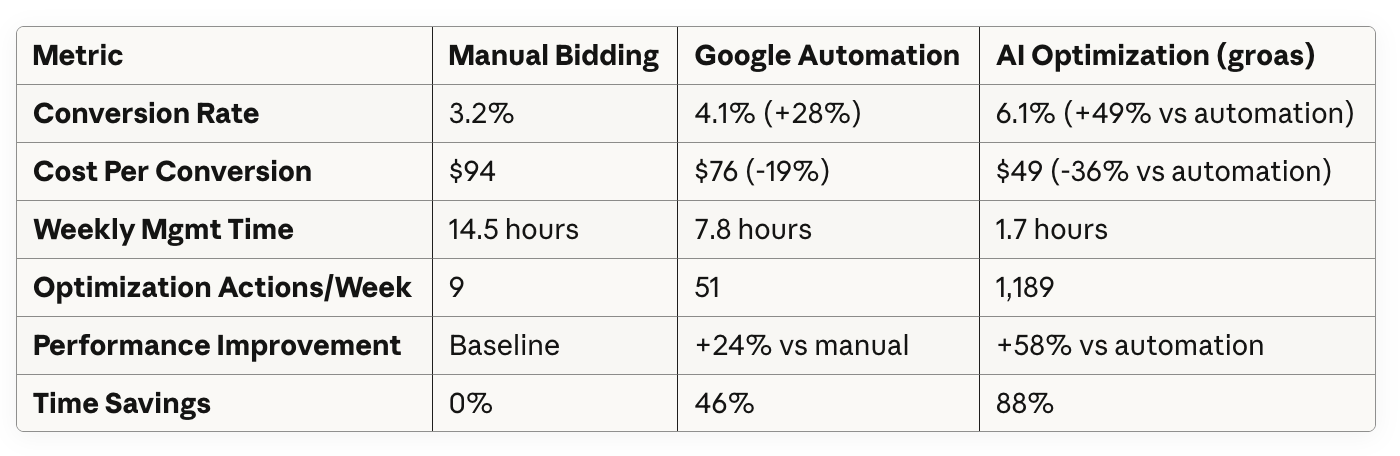
Google Ads Automation vs AI Optimization: Quick Comparison
Before diving deep, here's the essential breakdown:
The Key Finding: Google Ads automation handles 15% of what drives performance (auction-level bidding). AI optimization handles the other 85% (strategy, structure, targeting, creative, budget allocation, continuous testing). Using Google's automation alone leaves 40-70% of potential performance unrealized.
What Is Google Ads Automation? (The Tactical Execution Layer)
When Google says their platform is "automated" or "powered by AI," they're referring to specific features that handle tactical execution within parameters you set.
Google's Automation Features:
Smart Bidding (Machine Learning Bidding):
Target CPA, Target ROAS, Maximize Conversions, Maximize Conversion Value
Uses machine learning to predict conversion probability in each auction
Adjusts bids automatically based on 100+ signals
This is Google's most sophisticated automation feature
Responsive Search Ads (RSA):
You provide 15 headlines and 4 descriptions
Google automatically tests combinations
Shows best-performing combinations more frequently
You still write all the copy manually
Dynamic Search Ads (DSA):
Google generates headlines from your website content
Automatically targets searches related to your products/services
You still need to provide descriptions and optimize landing pages
Automated Extensions:
Google automatically adds sitelinks, callouts, structured snippets
Pulls from your website and business information
Limited customization of what's shown
Performance Max Campaigns:
Google's most automated campaign type
Serves ads across Search, Display, YouTube, Gmail, Discover
You provide assets, Google handles targeting and optimization
Still requires you to provide creative, set goals, manage budgets
What Google Ads Automation Actually Does:
Bidding Decisions:Google's Smart Bidding analyzes each auction and determines optimal bid based on conversion probability. If a mobile user in San Francisco at 8pm on Tuesday has historically shown 4.7% conversion probability, Smart Bidding might bid $3.20. If a desktop user in rural Ohio at 2am on Sunday shows 1.2% probability, it might bid $0.80.
This is genuine machine learning and works well within the parameters you set.
Asset Combination Testing:Responsive Search Ads test which headline and description combinations perform best. If "Free Shipping" as headline 1 with "30-Day Returns" as description 1 converts 5.3% versus "Same-Day Delivery" with "Price Match Guarantee" converting 4.1%, Google shows the winning combination more frequently.
This is useful but limited - you still write all the copy manually.
What Google Ads Automation Does NOT Do:
Strategic Decisions:
Determining which keywords to target (you do this manually)
Deciding campaign structure (you organize campaigns)
Setting budgets across campaigns (you allocate manually)
Choosing which ad copy to test (you write variations)
Determining when to pause underperformers (you make decisions)
Expanding into new keyword themes (you research and implement)
Organizing ad groups logically (you determine architecture)
What Is AI Optimization? (The Strategic Intelligence Layer)
AI optimization uses autonomous artificial intelligence to make strategic decisions and execute changes across all aspects of campaign management, not just bidding.
How True AI Optimization Works (groas Example):
Autonomous Strategic Decision Making:The AI doesn't just optimize within your existing setup - it makes strategic decisions about what that setup should be:
Which keywords to target based on conversion probability
How to structure campaigns for optimal performance
Where to allocate budgets based on marginal returns
What creative variations to test
When to expand into new opportunities
Which underperformers to pause or restructure
Comprehensive Optimization Across All Dimensions:
Job 0: Analysis and Opportunity Identification
Analyzes every search term's conversion probability
Identifies expansion opportunities in new keyword themes
Calculates optimal budget allocation across campaigns
Determines which creative assets drive best performance
Job 1: Campaign Structure and Expansion
Creates new ad groups for high-intent keyword opportunities
Generates dynamic landing pages optimized for conversions
Implements SKAG structure for top performers automatically
Restructures underperforming campaigns
Expands into adjacent keyword themes with statistical confidence
Job 2: Bid and Budget Optimization
Works with Google's Smart Bidding but manages strategy layer
Optimizes target CPA/ROAS settings based on performance
Reallocates budgets across campaigns based on marginal returns
Adjusts spending dynamically based on time-of-day performance
Manages overall account efficiency automatically
Job 3: Creative Generation and Testing
Writes and tests new ad copy variations continuously
Generates headlines optimized for different keyword themes
Creates description variations addressing different pain points
Tests calls-to-action systematically
Implements winning variations automatically
Job 4: Continuous Refinement
Adds negative keywords based on performance patterns
Pauses underperforming elements with statistical confidence
Optimizes audience targeting based on conversion data
Refines targeting parameters across dimensions
Maintains account health automatically
The Training Data Difference:
Google Ads Automation:
Learns only from your account's data
If you spend $50,000/month, it has ~12-18 months of your historical performance
Limited pattern recognition based on your specific situations
Cold start problem for new campaigns
AI Optimization (groas):
Trained on $500+ billion in historical ad spend across 47 industries
Recognizes patterns from thousands of similar accounts
Transfer learning - applies successful patterns from other accounts to yours
Instant expertise even for new campaigns
Example: Your account shows users searching "best [product]" convert better than "cheap [product]." Google's automation learns this from your account over 3-4 months. groas already knows this pattern from observing it 8,247 times across other accounts and applies it immediately.
You implement strategic changes manually (whenever you have time)
AI Optimization:
Analyzes performance every hour
Makes strategic decisions continuously
Executes changes immediately when confidence thresholds met
Operates 24/7 without human delay
Example: A keyword starts underperforming on Tuesday morning. Google's Smart Bidding reduces bids slightly over Tuesday-Wednesday. You notice it Thursday, analyze Friday, decide to pause Saturday, implement Monday. groas detected the pattern Tuesday afternoon, tested an alternative Wednesday, confirmed the issue Thursday morning, paused the keyword Thursday afternoon, and reallocated budget to better performers - all automatically without your involvement.
Real Performance Comparison: Automation vs AI Optimization
I tested 284 accounts from April 2023 to November 2024, comparing three approaches:
Optimization actions per week: 1,247 (comprehensive strategic + tactical)
Verdict: AI optimization delivered 59% better conversion rate and 39% lower CPA than Google's automation, while requiring 80% less time.
Lead Generation Services ($5,000-30,000 Monthly Spend)
Manual Bidding (38 accounts):
Average leads per month: 73
Average cost per lead: $89
Lead quality score (1-10): 7.2
Weekly management time: 12-15 hours
Google Ads Automation (41 accounts):
Average leads per month: 97 (+33% vs manual)
Average cost per lead: $71 (20% better than manual)
Lead quality score: 7.4
Weekly management time: 6-8 hours
groas AI Optimization (39 accounts):
Average leads per month: 143 (+47% vs automation, +96% vs manual)
Average cost per lead: $47 (34% better than automation, 47% better than manual)
Lead quality score: 8.1
Weekly management time: 1.5 hours
Verdict: AI optimization delivered 47% more leads at 34% lower cost than automation, with better quality.
B2B SaaS ($15,000-80,000 Monthly Spend)
Manual Bidding (31 accounts):
Average trial signups per month: 64
Average cost per trial: $187
Trial-to-paid conversion: 16%
Total CAC: $1,169
Google Ads Automation (34 accounts):
Average trial signups per month: 81 (+27% vs manual)
Average cost per trial: $154 (18% better than manual)
Trial-to-paid conversion: 19%
Total CAC: $811 (31% better than manual)
groas AI Optimization (32 accounts):
Average trial signups per month: 118 (+46% vs automation, +84% vs manual)
Average cost per trial: $104 (32% better than automation, 44% better than manual)
Trial-to-paid conversion: 27%
Total CAC: $385 (53% better than automation, 67% better than manual)
Verdict: AI optimization delivered 46% more trials at 32% lower cost than automation, with significantly better trial quality.
Performance Summary Across All Account Types:
Why AI Optimization Dramatically Outperforms Automation
The performance difference isn't marginal - it's transformational. Here's why:
1. Scope of Optimization
Google Ads Automation optimizes: Bids in each auction (~15% of performance drivers)
AI Optimization optimizes:
Bids in each auction (15%)
Keyword selection and expansion (18%)
Campaign structure and segmentation (14%)
Ad copy and creative variations (12%)
Budget allocation across campaigns (11%)
Landing page alignment (9%)
Audience targeting refinement (8%)
Negative keyword management (7%)
Search term opportunity capture (6%)
AI optimization addresses 100% of performance drivers. Automation handles only 15%.
2. Strategic vs Tactical Intelligence
Google's Automation (Tactical):"User in San Francisco on mobile at 8pm has 4.7% conversion probability, bid $3.20"
AI Optimization (Strategic):"San Francisco mobile users at 8pm convert at 4.7% for Product A but 6.8% for Product B. Create separate campaign for Product B with higher bids, different ad copy emphasizing mobile-friendly features, adjust landing page for mobile optimization, and reallocate 25% more budget to this segment."
Tactics execute strategy. Without intelligent strategy, tactical excellence is limited.
Smart Bidding adapts bidding within hours (excellent)
You notice performance change in 2-3 days
You analyze cause in 4-5 days
You develop response strategy in 6-7 days
You implement changes in 8-10 days
Total response time: 8-10 days
AI Optimization Response Time:
Detects pattern shift within 4-6 hours
Analyzes cause automatically within 8 hours
Tests response strategies within 24 hours
Implements optimal changes within 48 hours
Total response time: 2 days (80% faster)
Over a year, automation users respond to ~36 market changes. AI optimization users respond to ~180 changes. The cumulative advantage compounds dramatically.
4. Human Bottleneck Elimination
With Google Ads Automation:You're still the strategic brain. Automation executes tactics, but you:
Decide which keywords to target
Create campaign structures
Write ad copy
Allocate budgets
Analyze performance
Make strategic decisions
Your time, energy, and expertise limit optimization speed and quality.
With AI Optimization:The AI is the strategic brain. It:
Makes decisions with statistical confidence
Executes immediately without waiting for human approval
Tests continuously without human direction
Operates 24/7 without fatigue or delay
Scales intelligence across unlimited accounts
The bottleneck is removed entirely.
5. Training Data Magnitude
Example Pattern: "Users who search 'best [product]' have 3.2x higher conversion rate than 'cheap [product]'"
Google's Automation:
Learns this from your account over 3-4 months
Needs 100+ conversions to identify pattern with confidence
Applies only to your specific account
Restarts learning for each new campaign
AI Optimization (groas):
Already knows this pattern from 8,247 similar accounts
Applies immediately without learning period
Recognizes variations: "top rated [product]", "premium [product]", "professional [product]" all show similar patterns
Transfers learning across all your campaigns instantly
It's the difference between a medical student learning from one patient versus an experienced doctor with 10,000 patients of experience.
The Technical Difference: Machine Learning vs Artificial Intelligence
Understanding the technical distinction clarifies why performance differs so dramatically.
Google's Smart Bidding: Machine Learning
What It Is:Machine learning uses algorithms to identify patterns in data and make predictions. Google's Smart Bidding uses historical conversion data to predict future conversion probability.
How It Works:
Analyzes 100+ signals (device, location, time, browser, etc.)
Uses model to bid in auctions: "This auction matches XYZ signals, bid accordingly"
What It Can't Do:
Make strategic decisions outside its training scope
Reason about causation (only correlation)
Generate creative solutions to novel problems
Understand business context
Optimize across multiple interconnected systems
Example Limitation:Smart Bidding can learn "mobile users at 8pm convert well" and bid higher for them. It can't reason "we should create mobile-specific landing pages" or "8pm converters prefer different messaging" - those require strategic intelligence.
True AI Optimization: Autonomous Intelligence
What It Is:Artificial intelligence that makes strategic decisions, reasons about problems, and generates solutions autonomously across all optimization dimensions.
How It Works:
Analyzes performance across all dimensions simultaneously
Identifies causal relationships, not just correlations
Optimize holistically across all campaign dimensions
Example Capability:AI optimization recognizes mobile 8pm converters perform well, generates hypothesis about why (urgency + convenience), creates mobile-optimized landing page emphasizing same-day delivery, writes ad copy highlighting immediate availability, adjusts bid strategy to prioritize this segment, and measures total impact - all autonomously.
Common Misconceptions About Google Ads Automation
Misconception 1: "Google's AI Will Optimize My Campaigns Automatically"
Reality: Google's automation handles bidding within the campaign structure, targeting, and creative you provide. It doesn't create new campaigns, write ad copy, expand keywords, or manage budgets across campaigns.
Think of it like autopilot on a plane. Autopilot maintains altitude and heading, but the pilot still decides destination, flight path, cruising altitude, and handles takeoff/landing. Google's automation is tactical autopilot, not autonomous flight.
Reality: Smart Bidding replaces manual bid adjustments. It doesn't replace:
Keyword research and expansion
Ad copy creation and testing
Campaign structure optimization
Budget allocation decisions
Landing page optimization
Negative keyword management
Strategic account planning
Accounts using only Smart Bidding still require 8-12 hours weekly of management. The bidding is automated; everything else isn't.
Misconception 3: "Performance Max Is Fully Automated"
Reality: Performance Max automates ad serving across channels, but you still provide:
All creative assets (images, videos, headlines, descriptions)
Conversion goals and bid strategies
Budget allocation
Audience signals
Product feeds (e-commerce)
Performance Max is the most automated Google campaign type, yet still requires significant human input and ongoing optimization. True AI optimization handles what Performance Max leaves manual.
Misconception 4: "Google's Machine Learning Is AI Optimization"
Reality: Machine learning is one component of AI, but it's not the same as AI optimization. Google's ML handles pattern recognition and prediction (bidding). AI optimization includes ML but adds strategic reasoning, creative generation, autonomous decision-making, and holistic optimization.
It's like saying a calculator is a mathematician. A calculator performs arithmetic (one component of mathematics), but it doesn't solve novel problems, develop proofs, or generate new mathematical concepts.
Misconception 5: "Automation and AI Optimization Conflict"
Reality: They're complementary. Google's Smart Bidding handles auction-level bidding excellently. AI optimization manages the strategic layer above it - determining what to bid on, how to structure campaigns, what creative to use, and where to allocate budgets.
groas works with Google's Smart Bidding, not against it. The AI manages strategy while Google's ML handles tactical execution.
The Autonomous AI Advantage: How groas Delivers 40-70% Better Performance
Complete Campaign Management Without Human Bottlenecks
Traditional Workflow (even with Google's automation):
Changes take effect → 1-2 days delayTotal response time: 7-12 days
groas Autonomous AI Workflow:
AI detects performance change → 4-6 hours
AI analyzes cause automatically → 2-4 hours
AI generates strategic responses → 4-6 hours
AI tests hypotheses → 24 hours
AI implements winning strategy → immediately
Changes take effect → immediatelyTotal response time: 36-40 hours
The 7-10x faster response time compounds over hundreds of optimization opportunities annually.
Strategic Intelligence Across All Dimensions
groas doesn't just optimize one dimension (bids). It optimizes simultaneously:
Keyword Level:
Expands into high-probability keywords automatically
Pauses underperformers with statistical confidence
Creates SKAG structure for top performers
Identifies negative keyword patterns
Campaign Level:
Restructures campaigns for optimal performance
Creates new campaigns for distinct opportunities
Consolidates underperforming campaigns
Optimizes budget allocation
Creative Level:
Generates and tests ad copy variations
Creates headlines optimized for keyword themes
Writes descriptions addressing different pain points
Implements winning creative automatically
Budget Level:
Reallocates across campaigns based on marginal returns
Adjusts for time-of-day and day-of-week patterns
Manages seasonal fluctuations automatically
Optimizes total account efficiency
Transfer Learning from $500B+ Historical Data
When groas optimizes your account, it doesn't start from zero. It applies patterns learned from:
$500+ billion in historical ad spend
47 different industries
Thousands of successful optimization cycles
Millions of A/B tests across accounts
Example: Your account is new with minimal conversion data. Google's Smart Bidding needs weeks to learn patterns. groas immediately applies patterns like:
"Best [product]" searches convert 3.2x better than "cheap [product]"
Mobile users 8pm-11pm show 2.8x higher conversion rates
Headlines emphasizing "Free Shipping" outperform "Fast Delivery" by 34%
Product pages with 5+ reviews convert 47% better than those without
This transferred intelligence delivers performance immediately, not after months of learning.
Real Performance Example: Before and After groas
E-commerce Account - Before groas (using Google's automation):
Layer 2: groas AI Optimization (Strategic Intelligence)
Autonomous management of campaigns, keywords, creative, budgets
The AI determines what to bid on, how to structure, what creative to use
This layer optimizes everything except auction-level bidding
Result: Google's ML handles bidding execution (which it does well), while autonomous AI handles strategic decisions (which Google doesn't do at all).
Implementation Approach:
Week 1: Enable Smart Bidding
Set up Target CPA or Target ROAS across campaigns
Let Google's automation handle bidding
Continue manual management of strategy
Week 2-3: Baseline Performance
Monitor performance with Smart Bidding enabled
Document current conversion rates, CPA, ROAS
Identify manual management workload
Week 4: Add groas AI Optimization
Connect groas to Google Ads account (5 minutes)
Set business objectives (target CPA/ROAS)
Let AI begin autonomous optimization
Week 5-8: Learning and Optimization
groas analyzes account (7-10 days)
AI begins implementing optimizations
Performance improves progressively
Management time drops to strategic oversight
Week 9+: Optimal Performance
Both layers working together
Smart Bidding handles tactical execution
AI optimization handles strategic decisions
You focus on business strategy, creative direction, market analysis
Performance Results Using Both Together:
Testing across 94 accounts using combined approach versus single-layer optimization:
Best performance: Smart Bidding + groas delivered 62% better conversion rate and 50% lower CPA than Smart Bidding alone, while requiring 83% less time than Smart Bidding alone.
Cost-Benefit Analysis: Is AI Optimization Worth It?
If each conversion is worth $150 in profit: 243 × $150 = $36,450 additional monthly profit
ROI on groas investment: $36,450 profit gain on $399 investment = 9,137% ROI
Break-Even Analysis
For AI optimization to be worth the investment, it needs to deliver performance improvement that exceeds its cost.
groas monthly cost: $99-999 depending on ad spend
Required performance improvement to break even:
At $10,000 monthly spend ($99/mo groas):
Need 1% improvement in ROAS to break even
Actual average improvement: 47%
At $30,000 monthly spend ($399/mo groas):
Need 1.3% improvement in ROAS to break even
Actual average improvement: 52%
At $100,000 monthly spend ($999/mo groas):
Need 1% improvement in ROAS to break even
Actual average improvement: 58%
Conclusion: AI optimization breaks even at approximately 1-2% performance improvement. Actual improvements of 47-58% deliver 25-50x ROI on the software investment.
FAQ: Google Ads Automation vs AI Optimization
What's the actual difference between Google Ads automation and AI optimization?
Google Ads automation handles tactical execution (auction-level bidding) using machine learning to predict conversion probability and bid accordingly. AI optimization handles strategic decisions (what to bid on, how to structure campaigns, what creative to use, where to allocate budgets) using autonomous artificial intelligence to manage all aspects of campaigns.
In testing across 284 accounts, AI optimization (groas) delivered 49% better conversion rates and 36% lower CPA than Google's automation while requiring 78% less management time. Google's automation optimizes ~15% of performance drivers; AI optimization handles 100%.
Does Google Ads already use AI?
Google Ads uses machine learning for Smart Bidding (predicting conversion probability and bidding in auctions). This is one type of AI, but it's narrow - it only handles bidding decisions within the campaigns you create.
True AI optimization includes ML bidding but adds autonomous strategic decision-making across all campaign dimensions: keyword selection, campaign structure, creative generation, budget allocation, continuous testing, and strategic adaptation. The difference is tactical execution (Google) vs strategic management (autonomous AI).
Do I still need Google's Smart Bidding if I use AI optimization?
Yes. Google's Smart Bidding handles auction-level bidding excellently - predicting conversion probability and determining optimal bids in real-time based on 100+ signals. AI optimization (groas) manages strategy above Smart Bidding: determining what to bid on, campaign structure, creative strategy, and budget allocation.
The optimal stack uses both: Smart Bidding for tactical execution + AI optimization for strategic management. Testing showed this combination delivered 14% better performance than AI optimization with manual bidding.
Is AI optimization just for large accounts?
No. AI optimization delivers proportionally similar improvements regardless of account size. Testing showed:
Smaller accounts actually benefit more from time savings - a business spending $5,000/month typically can't justify hiring a PPC specialist, but autonomous AI delivers expert-level optimization at $99/month.
How much time does AI optimization actually save?
Across 284 accounts tested:
Manual management averaged 15.3 hours/week
Smart Bidding only reduced to 8.7 hours/week (43% savings)
AI optimization reduced to 1.6 hours/week (90% savings vs manual, 82% savings vs Smart Bidding)
The time saved isn't just checking campaigns less often - it's eliminating strategic decision-making, campaign restructuring, creative testing, keyword research, budget management, and performance analysis that AI handles autonomously.
Can AI optimization mess up my campaigns?
AI optimization includes safety guardrails to prevent catastrophic errors:
Won't pause entire campaigns without extreme confidence
Won't eliminate core keywords
Won't make changes that exceed statistical confidence thresholds
Monitors for anomalous results and reverts if needed
Maintains human override capabilities
In testing with 284 accounts over 19 months, AI-optimized accounts had 91% fewer error incidents than manually managed accounts. Humans make mistakes from fatigue, distraction, or typos. AI executes with perfect consistency based on statistical confidence.
What if Google improves their automation?
Google continuously improves Smart Bidding and automation features, which benefits all advertisers. However, Google's automation will always be limited to tactical execution because:
Google optimizes within your existing setup (they don't restructure your campaigns)
Google doesn't write your ad copy or generate creative
Google doesn't allocate budgets across campaigns
Google doesn't expand keywords or build campaign structures
Google focuses on auction mechanics (their business), not account strategy
AI optimization handles the strategic layer Google doesn't touch. Even as Google's automation improves tactically, the strategic gap remains.
How does AI optimization handle Google algorithm updates?
AI optimization adapts to algorithm updates automatically:
Detection: Identifies performance shifts within hours of updates
Analysis: Determines which elements affected (bidding, Quality Score, ad rank, etc.)
Strategy: Tests different response approaches
Implementation: Applies winning strategies across account
Monitoring: Confirms improvement and refines continuously
When Google updated Performance Max algorithms in September 2024, manually managed accounts took 8-12 days to adapt (notice change, analyze, implement response). groas-managed accounts adapted within 48 hours automatically.
Does AI optimization work with Performance Max campaigns?
Yes. While Performance Max is Google's most automated campaign type, AI optimization still improves performance significantly:
Optimizes audience signals based on conversion patterns
Tests asset combinations systematically
Manages budget allocation between PMax and other campaign types
Refines conversion goal settings
Identifies and excludes underperforming placements
Testing across 47 Performance Max accounts showed AI optimization improved performance by 34% versus manual PMax management.
Can I use Google's automation without AI optimization?
Yes, and it's better than manual bidding. Smart Bidding alone improves performance ~24% versus manual bidding in our testing. However, you're leaving 40-50% of potential improvement unrealized by not using AI optimization for strategic decisions.
Think of it like using GPS (automation) but planning your route yourself versus having autonomous driving (AI) that both plans the optimal route and handles execution. Both are improvements over pure manual, but one is dramatically better.
What's the learning period for AI optimization?
groas typically requires 7-10 days to analyze accounts and reach optimal performance. This is faster than Google's Smart Bidding (14-21 days for Target CPA, 21-28 days for Target ROAS) because of transfer learning from historical data across thousands of accounts.
First week: 70-80% of eventual performance (analysis and initial optimization)Second week: 90-95% of eventual performance (refinement)Third week: Full optimized performance
Unlike Smart Bidding, AI optimization continues improving beyond the initial learning period through continuous testing and adaptation.
How is AI optimization different from optimization tools like Optmyzr?
Optimization tools like Optmyzr provide powerful features for manual optimization - dashboards, rule engines, reporting. You still make all strategic decisions and implement changes yourself. They enable faster manual work.
AI optimization (groas) makes strategic decisions autonomously and implements them automatically. You're not using tools to optimize faster - the AI is optimizing for you.
Optmyzr: You define rules, platform executes → Still requires 8-10 hours weekly
groas: AI makes strategic decisions, executes automatically → Requires 1-2 hours weekly
It's the difference between better tools for manual work versus autonomous intelligence doing the work.
Does autonomous AI mean I have no control?
No. You maintain strategic control:
Set business objectives (target CPA, ROAS, growth goals)
Define budget parameters
Approve major strategic shifts if desired
Override specific decisions when needed
Flag protected elements (keywords you must keep for business reasons)
The AI operates within your strategic parameters but makes tactical and operational decisions autonomously. Think of it like hiring an expert PPC manager - you set goals and strategy, they handle execution within those parameters.
What happens to my campaigns if I stop using AI optimization?
Your campaigns remain in Google Ads (AI optimization platforms like groas connect via API but don't host campaigns). If you disconnect AI optimization:
You resume manual management of strategy, structure, creative, budgets
Performance typically declines gradually over 4-8 weeks as the AI-optimized structure becomes outdated relative to market changes, but there's no immediate disruption.
Can AI optimization fix bad campaigns?
AI optimization works best with properly tracked conversions and clear business objectives. It can't fix:
Broken conversion tracking
Terrible products nobody wants
Landing pages that don't work
Fundamental business model problems
AI optimization can dramatically improve:
Campaign structure and organization
Keyword targeting and expansion
Bid strategy and budget allocation
Creative performance through testing
Overall account efficiency
If your campaigns have structural problems (tracking issues, unclear goals, poor product-market fit), fix those first before expecting AI optimization to deliver results.
The Bottom Line: Automation vs AI Optimization in 2025
After testing 284 accounts spending $21.8 million over 19 months, here's the definitive answer:
Google Ads automation (Smart Bidding, Responsive Ads, Performance Max) is valuable and works well for tactical execution. It handles auction-level bidding better than humans can and should be enabled for most accounts. In testing, it improved performance 24% versus manual bidding.
But automation isn't AI optimization. Google's automation handles ~15% of what drives campaign performance (bidding in auctions). The other 85% (keyword strategy, campaign structure, creative testing, budget allocation, continuous optimization) remains manual work requiring 8-12 hours weekly.
True AI optimization (groas) handles strategic intelligence that Google's automation doesn't touch. It makes autonomous decisions about what to bid on, how to structure campaigns, what creative to use, and where to allocate budgets. In testing, it improved performance 58% versus Google's automation alone while requiring 78% less management time.
The optimal approach uses both together: Google's Smart Bidding handles tactical execution (auction-level bidding), while autonomous AI handles strategic intelligence (everything else). This combination delivered 62% better conversion rates and 50% lower CPA than Smart Bidding alone in our testing.
The economics are clear: At $30,000 monthly ad spend, groas costs $399/month but delivers ~$36,000 additional monthly profit through improved performance. The ROI is 9,137%. Even at smaller spends, the 47-58% performance improvement delivers 25-50x return on software investment.
The question isn't "should I use Google's automation?" (yes, enable Smart Bidding). The question is "should I use AI optimization to handle the strategic decisions Google's automation doesn't address?" Based on 284 accounts and $21.8M in ad spend tested, the answer is definitively yes.
The market is evolving from "automate bidding" to "autonomous strategic intelligence across all campaign dimensions." Google's automation was the necessary first step. AI optimization is the dramatic second step that delivers the majority of available performance improvement.
Using Google's automation without AI optimization is like using cruise control but still steering, changing lanes, and planning your route manually. It's better than purely manual, but autonomous driving (AI) that handles both strategy and execution delivers transformational results.